Creation of the Cassian Spring
The Calamitous BobThe Creation of the Cassian Spring is the posthumous miracle through which Cassia the Unbroken’s death becomes a lasting source of life. When the legendary priestess died after a long and fulfilling existence, the ground opened and a spring emerged; its waters continued to bear the blessing of Neriad, the god of courage and purity. Centuries afterward, the spring remains active in the ruins of the Harrakan Empire, preserving Cassia’s presence and saving Viviane Saint-Lys when ordinary endurance and protection have failed.
Origin in Cassia’s Death
The spring’s creation is inseparable from Cassia the Unbroken’s identity and service. She was a legendary priestess of Neriad, and her religious significance was matched by a public one: she fought not only for the Harrakan Empire but also for the other nations of the continent. The account presents her as universally loved, making her death more than the end of an individual life. It becomes a historical and sacred turning point in which devotion, courage, and political sacrifice are converted into a material blessing.
The transformation follows the completion of Cassia’s life rather than an abrupt or premature martyrdom. She died after what is described as a very long and fulfilling life, and only then did the earth open beneath her. The spring therefore functions as the visible consequence of a life brought to fulfillment. Its emergence binds bodily remains, landscape, divinity, and collective memory together: Cassia’s service enters the ground, Neriad’s blessing enters the water, and the resulting source continues to answer the needs of people who live long after the empire she defended has fallen.
The Sacred Spring in the Ruins
In the present-day cave, the spring is associated with the veiled remains of Cassia the Unbroken. An alcove has been dug into the rear wall, where the veiled body sits in a lotus position. The posture gives the remains an authority that suggests someone presiding over a gathering, although Viviane Saint-Lys recognizes that the figure is a corpse. Solfis identifies the body with the reverence usually reserved for deities, emphasizing that the location is not merely an abandoned room containing a mummy. It is a shrine-like space in which death continues to exercise power.
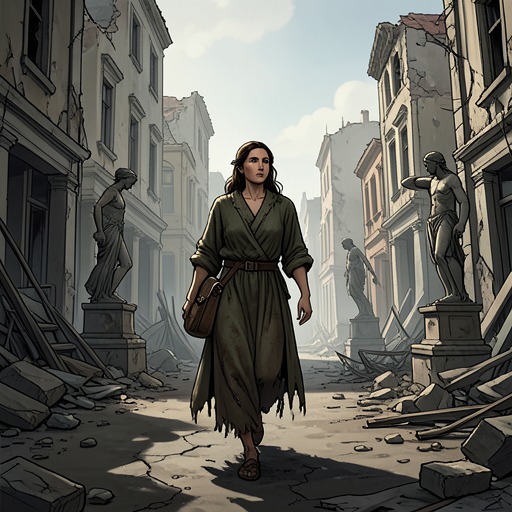
The spring also marks a surviving fragment of Harrakan civilization. Viviane Saint-Lys is struck by the evidence that the monsters, wastes, and ruins once belonged to a flourishing people with a vibrant culture. The sanctuary is one of the small surviving pearls of that lost world, a place where the past has not vanished entirely but remains physically present through water, ritual posture, and the remembered name of a priestess. The surrounding devastation makes the spring’s persistence more significant: against the broader ruin of the Harrakan Empire, this one site preserves a form of continuity.
Viviane Saint-Lys’s Restoration
The spring becomes decisive when Viviane Saint-Lys reaches it in a state of severe mana poisoning. The condition progresses through serious, ordinary, and mild stages before finally ending; once the waters have taken effect, she is no longer suffering from mana poisoning and is no longer dying. She wakes without pain for the first time in what feels like an age, exhausted and drained but alive. The spring’s salutary effect passes through her armor, cape, and skinsuit as though those protections were absent, while the warm water reaches her neck and leaves the rest of her body dry.
The rescue gives the event a clear reversal of value. Viviane Saint-Lys enters the sanctuary near death, burdened by the consequences of using magic, and emerges with her immediate crisis ended. The spring does not erase exhaustion or restore her to effortless strength, but it returns the possibility of continued action. Its power is therefore practical as well as sacred: the miracle preserves a body that can still travel, fight, and pursue the larger objective of survival and return.
The recovery is accompanied by a bodily sign of renewal. After her ordeal, a thin fuzz has begun to cover her scalp, like grass regrowing after a forest fire, and her skin no longer feels as dry as before. The image places Viviane Saint-Lys’s healing within the spring’s larger association with regeneration. The water does not merely interrupt death; it initiates the slow return of what damage had stripped away.
Recognition and Farewell
After recovering, Viviane Saint-Lys inspects Cassia’s remains and experiences the dead priestess as a presence of serenity, majesty, and completed purpose. The effect humbles rather than crushes her. Meditation comes easily, and she feels welcomed and protected, sensing that someone besides Solfis cares whether she survives. The spring’s sacred force is thus presented through an encounter rather than through an abstract theological claim: its blessing is experienced as shelter, recognition, and permission to rest.
Before leaving, Viviane Saint-Lys enters the waters one final time and stands before the veiled mummy. Cassia’s presence feels like a physical weight on her mind, but it produces humility rather than submission. Viviane understands that one individual can attain extraordinary heights through deeds and perhaps reach the gods through those deeds. She also recognizes the direct chain of obligation linking the ancient priestess to the present: she remains alive because of what Cassia did centuries earlier, another soul rescued long after the fall of the empire Cassia defended. Viviane thanks Cassia and Neriad, receives no spoken answer, and accepts the continuing comfort of the presence.
Narrative Significance
The Creation of the Cassian Spring turns the boundary between death and life into a site of exchange rather than a final division. Cassia is dead, yet her courage continues to nourish the living; the empire is ruined, yet one of its sacred achievements remains active; Viviane is dying, yet the past reaches across centuries to restore her. The event therefore mediates between history and myth, bodily decay and renewal, and the violence of the deadlands and the protective order of a sanctuary.
Its meaning is also carried by ritualized behavior. Viviane’s final immersion and formal thanks do not recreate the original miracle, but they acknowledge the sacred order that made her rescue possible. The spring’s waters provide an escape from the linear pressure of catastrophe, allowing an ancient act of service to recur as present salvation. In this sense, Cassia’s death is not simply remembered; it is continually made effective whenever the blessing reaches another endangered life.
The event’s importance extends beyond Viviane Saint-Lys’s private recovery. Later scenes retain the world of sacred allegiance, military sacrifice, and funeral practice: soldiers charge for Baran and the king, and survivors at Fort Sky separate the monsters from the lost, burn the bodies, and pray to Enttiku, an entity understood to be a god of the dead. Against those martial and funerary acts, the Cassian Spring offers a different legacy of courage. Cassia’s struggle is remembered not through a battlefield command or a pyre, but through water that still protects someone who was born centuries too late to know her.